The American Speech–Language–Hearing Association (ASHA) defines communication disorders as impairments in the processes of hearing, language, and/or speech. Communication disorders may be developmental (meaning they are present from early childhood) or acquired later in life. They can range in severity from mild to profound.
A communication disorder may occur due to a primary disability, or it may be secondary to other disabilities, such as autism spectrum disorder (ASD) or Down syndrome. A person may have one or any combination of the different types of communication disorders:
- Speech disorders, which involve difficulties with articulating speech sounds, fluency, and/or voice.
- Language disorders, which involve impaired comprehension and/or difficulty using spoken language, written language, and/or other symbol systems.
- Hearing disorders, which occur when the physiological auditory system’s sensitivity to sound is impaired.
- Central auditory processing disorder (CAPD), which involves impaired information processing of audible signals not caused by impaired peripheral hearing sensitivity or an intellectual disability.
Assistive Technology for Students with Communication Disorders
Students with communication disorders may benefit from Augmentative & Alternative Communication (AAC) systems. AAC systems attempt to compensate and facilitate, temporarily or permanently, for the impairment and disability patterns of individuals with severe expressive and/or language comprehension disorders.
Some types of AAC can be used as part of a Total Communication Approach — a holistic approach to communication that can include facial expressions, gestures, vocalizations, body language, American Sign Language (ASL), and more.
Some of the different types of AAC systems can include:
Printed Books or Boards
Paper-based AAC, like books and boards, helps students communicate using removable icons or by pointing to symbols or letters. These may feature the alphabet or QWERTY keyboards for spelling, context-specific vocabulary words, or a grid of core words.

Computer- or tablet-based speech-generating devices (SGDs)
These devices utilize text-to-speech (TTS) software and a dynamic touchscreen display. This touchscreen may be used by touch or accessed in alternative ways, including head tracking, eye gaze, and switch scanning for students with motor impairments. SGDs can contain large selections of vocabulary, as well as options for spelling words using QWERTY keyboards.

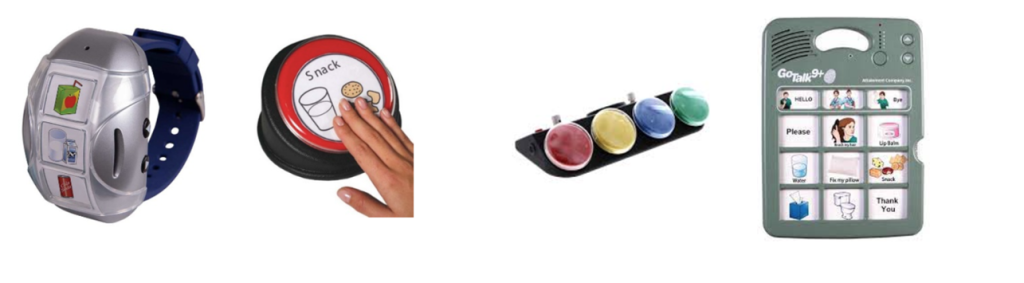
Voice-output communication devices
These devices come in many different forms, including:
- Single-message communication devices
- Single-button communication devices recorded with multiple messages
- Multiple-button communication devices with single messages
- Picture grids with recorded messages associated with each picture
- Wearable multi-message voice-output devices with static (non-changing) displays and built-in keyguards
Object-level devices
These devices rely on the user touching or exchanging 3-dimensional symbols, miniatures, or objects representing words and vocabulary.

Tactile symbols
This form of AAC uses symbols or objects with different textures that can be identified by touch for individuals with visual impairment.

Reference
The American Speech-Language-Hearing Association, Definitions of communication disorders and variations (1993, January 1).
FAQs
What is an assistive technology service?
An AT service is any service that directly assists a child with a disability in the selection, acquisition, or use of an assistive technology device. This can include services such as evaluations, purchase, maintenance or adaptation of AT devices, and training.
My child has been recommended an AT device(s) in an IEP. Where can I find resources to help me understand how to use this tool(s)?
Start with your child’s PPT or other school team involved with the recommendation – they should be able to help. If you know the name of the tool, you can also try searching their website for tutorials, videos, and guides about the product.
Who is responsible for paying for my child’s AT device?
If AT is recommended in a student’s IEP or 504 plan, the school district will need to pay for and provide it. This includes any equipment, service, or programs associated with the AT. If AT is not included in your child’s IEP or 504 plan, you may apply for funding through grants, insurance, or other means. Contact your school district for more information.
If the school system purchases AT for my child, is it mine?
AT purchased by the school system belongs to the school. However, if the school finds it necessary to be used at home, the AT can be borrowed for use at home.
My child is moving to a new school. Can we keep the same AT device?
If the device is part of your child’s IEP, yes. However, it may not be the exact same device. It is possible that a new — but comparable — device will be provided at the next school.
What happens if my child’s AT device breaks?
If an AT device (acquired through an IEP) is broken at school, the school system will replace it. However, if a device is broken at home, the student’s family may be responsible for paying for a replacement.
My child is graduating high school soon. What will be done to make sure of his/her future success?
CT statutes allow school districts, regional educational service centers, the Department of Education, and all other state and local governmental education agencies to loan, lease, or transfer an assistive device to the student (or the student’s family). Plus, AT is required to be part of a graduating student’s transition assessments. However, parents’ advocacy on behalf of the graduating student is essential.