Proper documentation of a student’s AT needs in their IEP plan is critical for their success. Let’s take a look at what information you need to add, and where.
AT Consideration
First, a note about the process of considering whether or not a student needs assistive technology. Consideration of AT should be a standard practice as per the CT AT guidelines. AT consideration is:
- A discussion among the IEP team about whether AT may support a student’s progress and independence.
- Required at every IEP review/revision meeting.
- Not a standardized practice — it looks different everywhere.
- Able to be done by anyone — it doesn’t require a specialist or “expert.”
- About features, not specific brands or programs.
- Much easier when you know what features and tools are out there.
What to Include
When documenting AT needs in an IEP, there aren’t any specific requirements, according to IDEA. However, resources like the State of Connecticut’s IEP Manual do provide guidelines for what should be included when it comes to assistive technology.
If AT is needed, the IEP must include how and when it is to be used. Written documentation helps maintain clarity and is essential for tracking a student’s progress. Plus, if a student moves to a new school, these records are especially important — without AT documentation, a new school won’t know exactly what a student needs.
The following are the key pages in an IEP where a PPT/IEP team should document a student’s specific AT needs.
Planning and Placement Team (PPT) Cover Page
The PPT cover page provides information about the student’s primary disability. It also documents their eligibility for special education and services (such as AT) as a student with a disability.
If a student is eligible for these supports, the PPT should check their specific disability in the “Primary Disability” checklist on the IEP.
Present Levels of Academic Achievement and Functional Performance
These pages of the IEP describe a student’s current strengths and areas of need, difficulties, and challenges in both academics and other areas (like social interaction). This includes their achievement in different school subjects (like language arts and math), plus their communication, vision, hearing, motor, and social-emotional skills.
Aside from documenting a student’s current skills and abilities, these pages help the PPT discuss their specific accommodations, AT devices and services, and modifications in the context of their individual needs.
Measurable Annual Goals and Short Term Objectives
This area of the IEP documents the services and supports they should receive in the context of their unique goals and objectives.
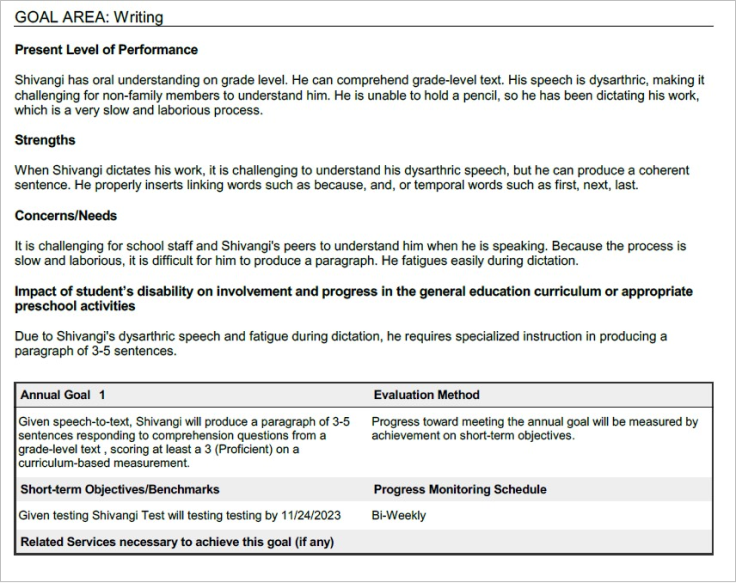
The IEP should document the student’s goals and objectives for each academic year. When creating goals, the PPT should refer to their current strengths and concerns. This is referred to as present levels of performance (PLOP).
- Strengths: How does the student currently utilize AT/AEM? How have these supports affected their academic and/or social skills?
- Concerns: Are there any barriers to the student’s learning that might be mitigated by AT/AEM? Are there any current barriers to utilizing AT/AEM?
Program Accommodations and Modifications
This page of the IEP documents all accommodations and modifications the student is entitled to, including AT devices and services. This documentation is critical to the IEP and ensures they’ll have access to the same devices and services even if they change school districts.
First, it’s important to understand the difference between accommodations and modifications in the context of special education.
- Accommodations change how a student learns — the curriculum remains the same. Examples include granting extra time for test-taking or providing materials with larger print.
- Modifications change what a student learns — the curriculum itself is modified. Examples include adjusting grading scales or assigning lower-level reading.
AT devices and services are considered accommodations and modifications to be listed in the IEP. The IEP team should consider the AT that will be appropriate for the specific setting the student participates in.

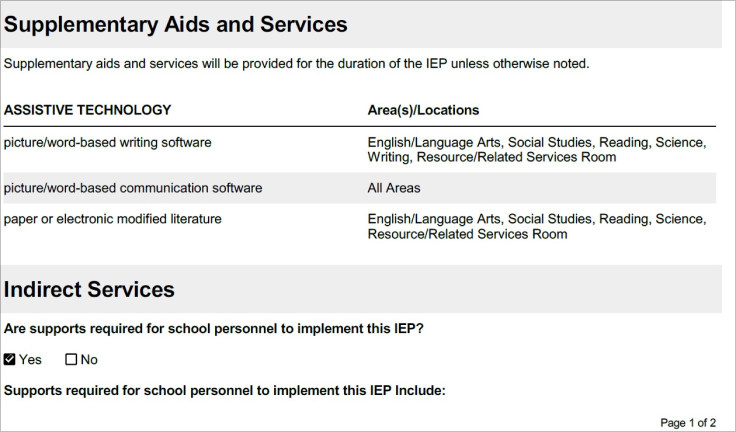
On this page, document the AT, accommodations, or modifications the student will receive, as well as where they will be used and for how long. The “where” and “when” of these supports are documented under the column “Sites/Activities Where Required and Duration.”
It’s important to be specific here. It’s not enough to write that a student will have access to AT in “all classes.” The simplest response to the “duration” portion of this page would be “all classes, all year.”
State and District Testing and Accommodations
Students who use AT/AEM may fully participate in district and state testing unless the PPT determines this is not appropriate.
This page of the IEP notes the student’s participation level in both district and statewide assessments. Which assessments will the student participate in, and will they participate with or without designated supports/accommodations? What are those designated supports and/or accommodations?
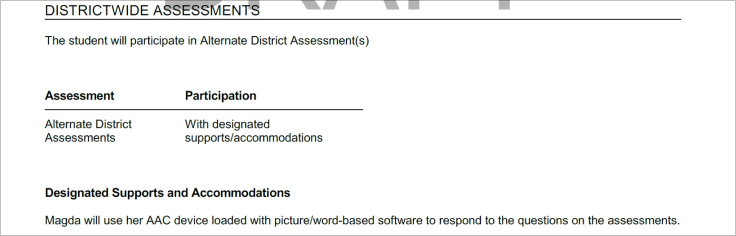
It’s important to ensure that a student receives similar supports/accommodations during testing and everyday instruction. The IEP should document the devices or services they use on a routine basis (for at least 30 days) under their supplementary aids and services.
Special Education, Related Services, and Regular Education
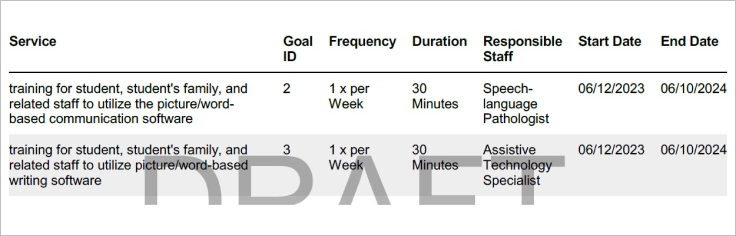
This area of the IEP documents several areas of a student’s educational and extracurricular supports, including AT or AEM services. It’s not necessary to document the AT itself on this page, but you do need to include any training or professional assistance needed to use it — such as disability training, AT training, in-class support (like an instructional aide/paraprofessional), and any other in-school support or accommodations. Descriptions should be specific about the frequency and duration of these supports, as well as who will provide and receive them. (Note: some IEPs may include this information along with Supplementary Aids and Services.)
The PPT should also consider whether the student and their family members need to be trained on using the AT device(s) or accessing AEM. Additional training throughout the student’s education may be required due to software updates or the addition of new features to the student’s device(s).